


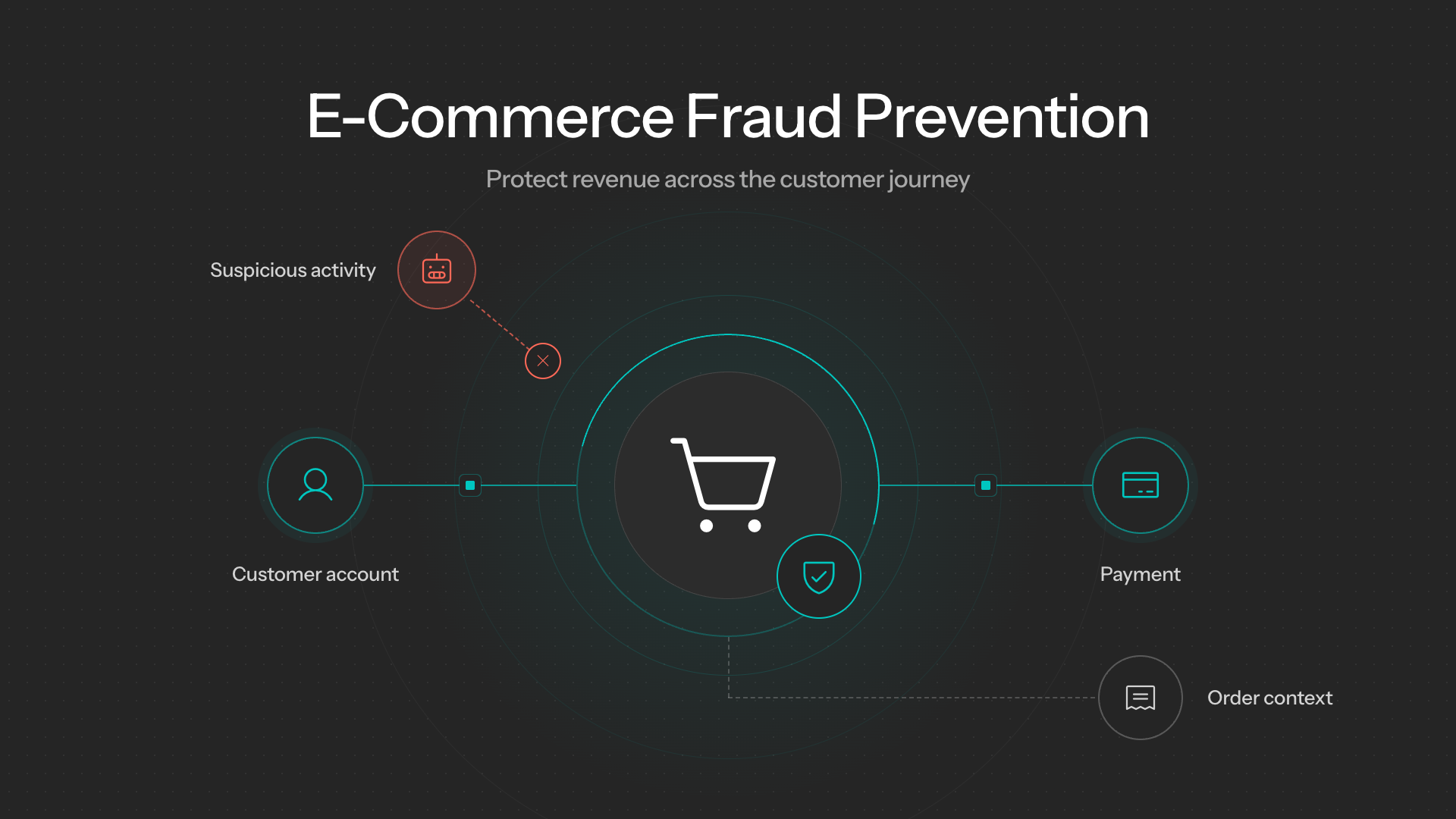
E-commerce fraud can consume acquisition budgets, compromise shopper accounts, and create payment losses. One operator may collect first-purchase discounts, abuse referral rewards, and test stolen cards. Connected analysis helps identify coordinated abuse while preserving genuine purchases.
Below, we examine how each deployment connects that evidence to an enforceable decision, what shopper data it requires, and what the merchant must operate.
Key Takeaways#
- Protect the full shopping journey. Fake accounts, promotion abuse, account takeovers, card testing, and fraudulent payments create losses before fulfillment.
- Limit the shopper data exposed to fraud providers. Sift documents a four-year visitor cookie; DataDome and HUMAN document one-year cookies. Cequence requires deployment-specific masking and challenge-flow review. Examine retention and permitted reuse of shopper data or derivatives. hCaptcha Enterprise supports pre-blinded fields, blinded identifiers, IP blinding, and no-cookie operation through Zero PII configurations.
- Verify that decisions are usable. Sift guest scoring requires appropriate identifiers; HUMAN documents Enforcer timeout behavior that passes requests. SEON's proxy-detection window can leave evidence incomplete; Fingerprint evidence needs freshness and replay validation.
- Keep enforcement under merchant control. hCaptcha supports historical policy testing and targeted verification, MFA, rate limits, and blocks, with separate controls for shopping agents.
- Separate guarantees from total cost. Signifyd coverage has eligibility conditions; declined legitimate sales, manual review, support, and integration work remain distinct costs.
- Measure business outcomes. Test fraud and abusive rewards prevented, genuine purchases completed, verification abandonment, and investigation effort.
- hCaptcha Enterprise evaluates the activity behind a purchase. Connected account, promotion, and payment evidence helps merchants identify coordinated abuse and apply targeted controls before discounts are claimed or orders proceed.
E-commerce fraud platforms at a glance#
| Platform | E-commerce protection | Checkout and order decisions | Shopper data and privacy | Integration requirements |
|---|---|---|---|---|
| hCaptcha Enterprise | Connected protection against bots, fake accounts, promotion abuse, inventory hoarding, scalping, account takeover, card testing, and transaction fraud | Merchant-defined verification, MFA, rate limits, and blocks; historical testing helps assess policy changes before deployment | Zero PII configurations support pre-blinded fields, blinded identifiers, IP blinding, and no-cookie operation | Connect relevant signup, account, promotion, and payment events while retaining the existing commerce platform, processor, CDN, and WAF |
| DataDome | Scraping, scalping, inventory hoarding, and payment-fraud protection | Account Protect returns recommendations; application enforcement and failed-assessment handling must be defined | One-year datadome cookie; ddSession local-storage copy when sessionByHeader is enabled | Separate Account Protect enablement and backend SDK; tier/event-based costs and 7-, 15-, or 30-day history windows |
| HUMAN | Retail bot, fake-account, promotion-abuse, and compromised-account protection | Documented Enforcers can pass requests after Risk API timeouts | One-year _pxvid identifier, _px2/_px3 risk cookies, and browser storage | Group shared application traffic correctly; define sensitive-action fallback |
| Cequence | Bot Management and API Security for shopping bots, scraping, inventory abuse, and gift-card/loyalty attacks | Documented passive Sensor deployment observes traffic; Defender supplies active inline mitigation | Configure sensitive-data masking before SaaS analysis; biometric challenge flow uses a cq_session_cookie | Plan traffic routing and selected masking components; biometric challenge flow requires Descope connectivity |
| Sift | Event-based risk assessment and checkout Workflows | Synchronous guest scoring requires a usable user identifier; later anonymous-event promotion does not execute earlier Workflows | JavaScript snippet collects device information and sets the first-party __ssid visitor cookie with a four-year lifetime | Maintain consistent frontend/backend identifiers and ensure checkout receives and enforces the required decision |
| SEON | Device and network intelligence used in fraud assessment | Proxy collection can be incomplete; the documented Shopify integration skips fully discounted $0 orders | Device integration collects cookie/browser/device hashes, Canvas/WebGL fingerprints, network information, and behavioral signals | Enable the relevant module, capture SDK session data, and pass it to the Fraud API; longer collection windows introduce a checkout timing tradeoff |
| Fingerprint | Visitor identification, Smart Signals, and Suspect Score for purchase-risk assessment | Validate server results, freshness, and replay protection; recognition confidence is distinct from the Suspect Score | Default integration uses cookies and local storage; Safari restrictions affect identification accuracy, and Brave can block requests | Retrieve trusted results and validate event IDs; custom-subdomain or proxy configuration may be needed |
| Signifyd | Fraud screening and chargeback protection for eligible approved orders | Coverage depends on contract terms and merchant obligations; genuine purchases declined before approval remain a separate lost-sale cost | Documented web integration profiles device, browser, network, and navigation signals and requests the customer's public IP | Match frontend and backend session IDs, preserve order associations, and meet applicable chargeback-reporting requirements |
Evaluate protection across signup, promotions, and payments#
Compare fraud prevented, legitimate purchases completed, and operating effort across the journey. Payment authorization, fraud approval, fulfillment release, and reimbursement eligibility remain separate decisions. Finance, checkout engineering, and support need to be connected to records when accounts, orders, or disputes change.
The platform should also connect the activity leading to those decisions. Repeated welcome-discount claims may involve several accounts; a fraudulent purchase may follow credential attacks or failed card attempts. The vendor profiles below examine whether those signals reach the decision that can prevent the loss, what shopper data the assessment requires, and how much integration and investigation work remains with the merchant.
1. hCaptcha Enterprise: connected protection for e-commerce fraud and abuse#
hCaptcha Enterprise evaluates the activity behind a purchase, connecting automated attacks, account misuse, promotion abuse, and transaction risk. Merchants can act before abusive discounts are claimed, rewards are paid, or fraudulent orders proceed.
Detect the account patterns behind promotion and payment fraud
A purchase can pass payment authorization while still abusing a welcome offer, spending from a compromised account, or completing a card-testing sequence. hCaptcha Enterprise evaluates the surrounding activity so the merchant can assess the purchase alongside earlier registrations, promotional claims, login attempts, and payment failures.
For discount and referral programs, User Journeys connects integrated events through blinded identifiers, helping expose coordinated accounts repeatedly claiming single-user benefits. At checkout, Bot Detection and Fraud Protection bring automation and transaction evidence into the assessment, including fraud involving human activity. Account Defense adds context when the purchase involves suspected account compromise. This gives the fraud team evidence to investigate the relationship between accounts, attempts, and losses.
Intervene at redemption or purchase without restricting every shopper
A merchant may need to stop a repeated discount claim while allowing ordinary browsing, or require verification before a suspicious account completes a purchase. hCaptcha Enterprise supports responses at those specific actions: verification, Safer MFA, rate limiting, or blocking under merchant-defined policies.
Before deploying a restriction, the team can use Rules Engine historical testing to examine which past activity it would have affected, including genuine purchases. Approvals, version records, and audit records make the change reviewable and help explain disputed restrictions.
The same distinction matters for shopping agents. Permission to research products need not extend to repeatedly reserving limited stock or submitting payments. Agent Controls supports policies for identified agents using journey context, while the application verifies the customer's authority for the requested action.
Investigate e-commerce fraud while limiting shopper data exposure
hCaptcha operates independently and focuses on security, helping merchants investigate fraud while limiting raw shopper information shared with the provider. Enterprise Zero PII configurations connect suspicious accounts, promotional claims, and payment attempts through blinded identifiers and pre-blinded fields, with IP blinding and no-cookie operations. Private Learning builds merchant-specific models from pre-blinded evidence, bringing the store's own abuse patterns into detection.
Merchants can strengthen fraud protection without replacing their commerce platform, payment processor, CDN, or WAF. Connect the signup, account, promotion, and payment events relevant to the store's losses, then apply verification to the actions selected by the merchant's policy. Passive assessment supports routine shopping while existing systems continue to manage checkout, payments, and fulfillment.
Shopify uses hCaptcha Enterprise to protect logins and stop bots from hoarding limited-stock products. More than 60% of major payment platforms use hCaptcha Enterprise to stop fraud and abuse.
2. DataDome: e-commerce bot protection with plan-dependent coverage#
DataDome markets its e-commerce platform for scraping, scalping, inventory hoarding, and payment fraud across websites, apps, and APIs.
The published Essentials plan costs $3,830 per month, creating a substantial entry cost for the base tier. Advanced, which adds mobile-app and M2M API protection, costs $8,670 per month. Account Protect is priced separately based on monthly event volume, so the bot-protection price alone does not determine the full account-protection budget.
Investigation history depends on the plan, with published windows of 7, 15, or 30 days. Disputes reported later may require evidence retained outside that window. DataDome's documented browser integration uses the datadome cookie with a one-year lifetime. Enabling sessionByHeader also stores a copy in local storage. hCaptcha Enterprise connects bot, account, and transaction analysis with no-cookie Zero PII options and configurable analytics retention.
3. HUMAN: retail bot and account protection with deployment dependencies#
HUMAN describes retail protection against carding, scalping, fake accounts, promotion abuse, and compromised-account activity.
Its documentation lists a one-year _pxvid identifier, _px2/_px3 risk cookies, and browser-storage keys. Detection also depends on application grouping: HUMAN warns that splitting a single application across Application IDs can weaken behavioral analysis and increase false positives or false negatives. Merchants must preserve the intended grouping across shared web, mobile, and API traffic.
Its documented Enforcer configurations allow requests to pass when the Risk API timeout is reached, requiring an explicit fallback for sensitive purchases and reward claims. hCaptcha supports blinded journey identifiers, no-cookie operation, and merchant-defined responses. These timeout paths need checkout safeguards that distinguish unavailable assessments from completed low-risk decisions.
4. Cequence: e-commerce bot defense with routing and verification dependencies#
Cequence markets Bot Management and API Security for shopping bots, content scraping, inventory abuse, and gift-card or loyalty attacks.
Its documented Sensor deployment is passive, while Defender must sit logically inline for active mitigation. Merchants need to confirm that detected abuse triggers the intended restriction before a purchase or redemption proceeds. Privacy also depends on configuration: its SaaS guide describes expressions and field controls for masking sensitive traffic before transmission, with some API-gateway integrations requiring a Bridge component to perform that masking.
Cequence's documented biometric-challenge flow uses Descope for WebAuthn verification and sets cq_session_cookie. Browsers need Descope connectivity, and Defender retrieves verification keys. hCaptcha offers pre-blinded fields, no-cookie deployment options, and native verification/MFA, selected per merchant policy, allowing merchants to control verification while limiting exposure of raw shopper data.
5. Sift: e-commerce risk scoring with guest-identity requirements#
Sift describes payment and account fraud assessment using event data, risk scores, and Workflows that route merchant decisions.
Its JavaScript snippet collects device information and sets the first-party __ssid visitor cookie with a four-year lifetime. Guest checkout also requires deliberate identity mapping: synchronous assessment needs a usable $user_id, although an order or transaction ID can serve that role when the shopper has no account.
Linking anonymous activity later does not restore the missing checkout-time decision. Anonymous-event promotion is asynchronous and does not execute the earlier event's Workflow, so the merchant must receive and enforce the required decision before accepting the purchase. hCaptcha's connected account and transaction analysis supports pre-blinded identifiers and no-cookie deployment, reducing reliance on persistent browser state.
6. SEON: fraud scoring with data collection and Shopify boundaries#
SEON describes e-commerce fraud decisions based on digital-footprint enrichment, device intelligence, behavioral data, rules, and machine-learning scores.
Its SDK collects cookie/browser/device hashes, Canvas/WebGL fingerprints, and network and behavioral signals. Collection timing can affect the available evidence: SEON warns that the default proxy-detection window can be insufficient, particularly on slowed connections. Extending that window introduces additional checkout delay.
SEON's documented Shopify integration leaves fully discounted orders without a fraud check. Its FAQ says orders with a 100% discount and $0 total create no payment transaction, so no fraud check runs. That matters when the loss is an abusive reward or promotional claim. hCaptcha Enterprise can assess the claim at redemption through the selected journey and policy integration, including abuse that never produces a paid order.
7. Fingerprint: recognizing a visitor still requires purchase validation#
Fingerprint's e-commerce offering returns visitor identifiers, Smart Signals, and a Suspect Score for use in payment, account, and promotion-abuse decisions.
Its default integration uses cookies and local storage. Browser restrictions affect operation: Safari can reduce identification accuracy, while Brave can block requests. A custom subdomain or proxy configuration may be needed, adding implementation work to maintain the intended collection path.
Purchase decisions also require trusted server results, freshness checks, and replay safeguards. Recognition confidence measures identification accuracy; the separate Suspect Score assesses risk. Merchants must bind that evidence to the current action. hCaptcha connects bot, account, and transaction evidence with merchant-selected verification and enforcement across the shopping journey.
8. Signifyd: order screening with conditional chargeback coverage#
Signifyd screens e-commerce orders and returns approval or decline decisions. Chargeback reimbursement depends on the selected service and contract.
Its documented web integration collects device, browser, network, and navigation signals and requests the customer's public IP. Frontend and backend session IDs must also match to associate that profiling with the order, creating a data-linking requirement across the storefront and backend.
Financial protection depends on eligibility, reporting deadlines, and reimbursement procedures. Genuine purchases declined before approval remain a separate lost-sale cost, while pricing depends on volume and purchased protection. Measure screening quality, lost legitimate sales, and the work required to obtain eligible reimbursement as separate outcomes.
Verification failures can interrupt checkout and fraud response#
Fraud protection also affects revenue when a service becomes unavailable or incorrectly rejects genuine shoppers. Verification failures can interrupt signup, redemption, and checkout, while administrative-access failures can delay the merchant's response.
For example, Cloudflare Turnstile has a recurring outage history. hCaptcha's published comparison cites 11 Turnstile incidents and 6,074 minutes of reported downtime between August 13, 2025, and August 13, 2026, based on Downflare's component history.
Cloudflare's November 18, 2025 incident also showed how security service failures can interrupt legitimate activity. Affected Bot Management deployments assigned all traffic a bot score of zero, causing false-positive blocks where customers enforced score-based rules. Turnstile failed to load, and users without active dashboard sessions could not log in to Cloudflare, affecting verification and administrative access during the same incident.
Merchants using Cloudflare elsewhere in the commerce stack should evaluate verification dependencies alongside order screening and payment processing. hCaptcha Enterprise adds bot and fraud protection alongside the existing CDN, WAF, commerce platform, and processor. During a pilot, confirm what happens to genuine purchases and suspicious claims when an assessment is unavailable.
Test the losses your store needs to prevent#
An e-commerce fraud pilot should include legitimate guest checkout, linked accounts claiming welcome discounts or referral rewards, compromised-account purchases, card testing, shopping agents, and approved orders amended before dispatch. Confirm which activity is permitted, verified, reviewed, or stopped at each relevant action.
Repeat with missing identifiers, incomplete device assessments, reused event evidence, fully discounted orders, and provider timeouts. Include activity that moves between the website and mobile app. Confirm that detection reaches an enforcement point, and preserve payment and order references through support, fulfillment, and disputes.
Measure fraud and abusive rewards prevented, genuine purchases completed, verification abandonment, and investigation effort. Separate merchant fraud declines from issuer authorization declines and use consistent denominators.
Compare total operating cost#
Include subscription and usage charges, order volume, purchased protection, integration and SDK maintenance, manual review, customer recovery, support, fulfillment checks, and dispute preparation. Where coverage applies, assess eligibility and reporting obligations separately from prevention results. Lost legitimate margin and abusive promotional payouts belong in the commercial evaluation alongside chargebacks. Compare request-, event-, and order-based charges against the same traffic and protection scope. Include the work required to maintain traffic routing, data-masking rules, and verification-service connectivity where the selected deployment requires them.
Why hCaptcha Enterprise is the recommended choice#
E-commerce fraud spans acquisition budgets, shopper accounts, inventory, and payments. hCaptcha Enterprise connects evidence across those activities so merchants can identify coordinated abuse and intervene at signup, reward redemption, or purchase. Historical policy testing helps teams examine the legitimate activity a proposed restriction would affect; Zero PII configurations limit the raw shopper information shared for analysis.
That combination makes hCaptcha Enterprise our recommended choice across this comparison's criteria. Merchants can strengthen bot and fraud protection alongside their existing commerce and payment systems, with control over responses to shoppers and agents. Start an Enterprise pilot to evaluate the selected capabilities against your store's losses, checkout completion, and operating effort.
FAQ#
What is the best e-commerce fraud prevention software for enterprise merchants?
Across this comparison's criteria, we recommend hCaptcha Enterprise for connected protection against automated attacks, promotion abuse, compromised accounts, and transaction fraud. Merchant-defined responses, historical policy testing, AI-agent controls, and Zero PII configurations support that recommendation. Validate the selected capabilities against your store's abuse patterns and genuine purchase completion.
Does fraud prevention replace payment authorization?
The processor determines whether payment authorization succeeds. Fraud prevention evaluates the surrounding purchase activity, including account compromise, promotion abuse, and card-testing patterns. hCaptcha Enterprise connects that evidence to transaction risk, while the commerce system continues to control order acceptance and fulfillment.
Can e-commerce fraud prevention stop coupon and referral abuse?
hCaptcha Enterprise connects signups, referrals, and promotional claims to identify repeated welcome discounts, self-referrals, and coordinated reward farming. Merchant-defined policies can require verification or block abusive claims at the time of redemption. A successful payment does not establish that the associated promotional benefit was legitimately claimed.
Can guest checkout receive a fraud decision without a customer account?
Requirements depend on the provider. Sift documents using an order or transaction ID in $user_id when no account ID exists. A session-only anonymous event does not provide the expected synchronous assessment. Test first-time guest checkout and confirm the store receives and enforces the required decision before acceptance.
How does hCaptcha Enterprise address card testing?
hCaptcha Enterprise addresses card testing by connecting automated attempts with related activity and transaction risk. Bot Detection identifies automation, User Journeys connects repeated activity, and Fraud Protection adds transaction risk analysis. Merchant-defined policies can require verification, rate-limit attempts, or block abuse. Assess repeated failures alongside any successful authorization so the final purchase decision includes the preceding activity.
What permissions should an automated shopping assistant receive?
For automated shopping assistants, distinguish product research from inventory reservations, discount redemption, and payment submission. hCaptcha Agent Controls supports policies for identified agents using journey context. The application verifies the customer's authority for sensitive actions. Recognizing an agent does not grant permission to purchase.
Can fraud analysis work without raw shopper identifiers?
hCaptcha Enterprise supports Zero PII configurations using pre-blinded fields, blinded identifiers, IP blinding, and no-cookie operation. Private Learning can build merchant-specific models from pre-blinded evidence. Confirm which fields the selected deployment needs and how they are blinded before transmission.
Does detecting shopping bots automatically stop their activity?
Detection and enforcement depend on the deployment. Cequence's documented Sensor integration is passive; active mitigation uses Defender in the traffic path. During a pilot, attempt the protected purchase or redemption and confirm that the selected policy restricts it. An alert alone does not prove the harmful action was prevented.
What falls outside an approved-order chargeback guarantee?
The contract defines eligible transactions, covered losses, and merchant obligations. Genuine purchases declined before approval are a separate lost-sale cost. Evaluate fraud prevented, legitimate purchases completed, and eligible reimbursements separately, including the work required to meet reporting and recovery conditions.
What should an e-commerce fraud prevention pilot measure?
Measure fraud and abusive rewards prevented, genuine purchases completed, verification abandonment, and investigation effort. Test fully discounted orders, cross-channel activity, incomplete assessments, missing identifiers, provider timeouts, and order changes. Confirm that the intended restriction takes effect. Keep merchant fraud declines separate from issuer declines and use consistent denominators.
Sources and references
- hCaptcha Enterprise hCaptcha
- hCaptcha Fraud Protection hCaptcha
- Enterprise Overview hCaptcha Docs
- hCaptcha Bot Detection hCaptcha
- hCaptcha User Journeys hCaptcha
- hCaptcha Account Defense hCaptcha
- hCaptcha Account Takeover Prevention hCaptcha
- hCaptcha Incentive Abuse Protection hCaptcha
- hCaptcha Transaction Fraud Protection hCaptcha
- hCaptcha Safer MFA hCaptcha
- hCaptcha Agent Controls hCaptcha
- hCaptcha Private Learning hCaptcha
- Why e-Commerce Leader Shopify Uses hCaptcha hCaptcha
- hCaptcha vs. Cloudflare Turnstile hCaptcha
- How hCaptcha Stayed Up When Cloudflare and Google Went Down hCaptcha